Showing posts with label morality. Show all posts

Tuesday, May 16, 2017

A World of 6.5 Billion Truths

Right or wrong.

There is a distinct and discernible difference between the two.   

This increasingly morally relativistic world would like us to think that it is comprised of 6.5 billion shades of gray, but honestly there are far more issues in the world that come down to a truly black or white decision than what we may believe; that come down to a choice between a falsehood or truth.  There is a right answer and a wrong answer.  There is the correct path and the path that leads to desolation.

I know— I know—

How presumptuous of me!  After all, I haven’t walked in your shoes so I don’t know what issues you have had to face. 

And that is true.  I haven’t walked in your shoes.  Perhaps I have been in similar circumstances and faced adversaries or dilemmas that were very much like the ones you have faced, but that doesn’t mean they are exactly the same.

But, that doesn’t mean that truth changes because circumstances are slightly different for you either.

I have often heard in recent years some version of “it’s her truth” or “that is the truth as he sees it”.  Well folks, that may or may not be THE truth.  Rather, that is their perspective. 

Truth is not subjective.  It simply is.  It is factual and unwavering, no matter how much one hopes to color it in deeper shades of gray with one’s own individual circumstances.  It does not change based on one’s gender, color, sexual orientation, political ideology, shoe size, or for which NBA team one cheers. 

God is Truth.

“Gasp!  Well what if I don’t believe in God?  What then?”

What then, indeed?  That is actually a very good question.  If my statement is correct that God is truth, and you don’t believe in God, then how do you define or determine what truth is?

When the Jewish priests handed Christ over to Pontius Pilate, they did so because Jesus challenged “their truth”. 
So Pilate said to him, "Then you are a king?" Jesus answered, "You say I am a king. For this I was born and for this I came into the world, to testify to the truth. Everyone who belongs to the truth listens to my voice."
Pilate said to him, "What is truth?" When he had said this, he again went out to the Jews and said to them, "I find no guilt in him.”   ~John 18: 37-38
You can almost hear Pilate spit out his response, “What is truth?”  The irony is that The Truth was standing right before Pilate and was crucified because He contradicted the Romans’ and the Jews’ version of the truth.

But back to our original question.  If you don’t believe in Christ –in God- then how do you define and determine what is the truth?

Is our government the arbiter of truth?  As American’s we’d like for them to be, but honestly if you assume that simply because the government says it is so and therefore the truth, you will be sadly mistaken more often than not.

Do we look to teachers, professors, family, or friends to determine what is right and wrong ...what  is the truth?  Sometimes.  Sometimes we are met with wise counsel from these good people too.  But they are still human and therefore subject to the same foibles and failings that you and I are.  They can make mistakes, even when discerning what the truth is.  The wisest and most holy man or woman on earth can still be mistaken and lead one away from the truth.

“Exactly! So if I cannot count on anyone else to lead me to the truth and I don’t believe in God, then I guess I just have to count on myself to define my own truth.”

Easy there, Skippy! 

Do you really think you are going to be any less prone to errors in choosing between right and wrong and finding the truth than the wisest and most holy among us?  That is rather arrogant if one is searching for THE truth, instead of just a version that fits your specific wants, desires, and perceptions.

But if God is a myth and you cannot necessarily depend on others, then the only person you have to answer to is yourself, right?   This journey of yours is singular. It is a lonely walk that you must take by yourself. No one can guide you, direct you, or tell you which way to go. You alone must chart your course because you alone know your circumstances –your truth.  You get to decide what is right and true for you, even if it conflicts with what your parents, teachers, or society says is right and true.  After all, they aren’t living “your truth” in your circumstances, right?

It is in defining these alternate individual “truths” that we each come to justify our own immoral actions.  Shacking up with our girlfriend/boyfriend, living a homosexual lifestyle, promoting or procuring an abortion, lying, cheating, polluting our planet, or ignoring the least among us in need all become permissible if the ultimate arbiter of truth is ourselves – if we are the ones that determine what is true.

There are two faculties or powers of the immortal soul that are given to us by God.  They are reason and free will. Using our reason, we can think about things such as the morality of a proposed action as defined by God ...as defined by the Truth. Using our free will, we can decide whether to do it. Faculties that we share with animals are senses and emotions. Our emotions are more varied and complex than those of animals, though there is no denying that my dog can be happy with his tail wagging at a frenzied pace as we play fetch or scared when he sees the car approaching the dreaded veterinarian’s office.

We call reason and free will higher faculties; emotions and senses are our lower faculties. It is a serious mistake, though one that is common in our culture, to allow the lower faculties to govern our actions. This leads us to believe that a proposed action must be good if it is pleasurable to our senses or if it makes us feel happy. I have heard individuals justify immoral acts by saying, “God wants me to be happy.” This is true, but there are acts that will give us momentary pleasure but not long-term happiness. God wants us to live in eternal happiness, and to use reason rather than emotion and sensual pleasure to guide us there.  Drugs, alcohol, or promiscuous sex may give us momentary pleasure, but in the long run will only lead us to more sorrow and misery.

All of us sinners have, to one degree or another, bought into the lie. At the heart of the lie—and we can see it in the Genesis account—is the deification of the ego. I become the center of the universe, I with my needs and my fears and my demands.  And when the puny “I” is the center of the cosmos, the tie that binds all things to one another is lost. The basic reality now becomes rivalry, competition, violence, and mistrust.  And The Truth is subjugated in the world to “my truth” and the varying “truths” of billions of other people whom fail to seek, acknowledge, and live by The Truth that is God.

In such a world, right and wrong are always relative.  In such a world there is no singular transcending all-encompassing Truth.


As for me and my family, we will always strive to serve the Lord ...and The Truth.

Thursday, April 4, 2013

A Refutation of the Case for Gay "Marriage"

I had made it a point to try and restrain myself from writing on temporal matters during Lent and so of course found much in the way of temptation that just cried out for my vitally-needed input into the various debates that occurred over the course of these past forty days.  Unfortunately one of those critically important debates was focused on the topic of gay “marriage” as our Supreme Court heard arguments on this matter last week during the holiest week on the Christian calendar.  Irony abounds as we as a culture further turn away our faces from God and His will and concentrate rather on what we want as self-indulgent adults in our “enlightened and compassionate society” today.

Marriage throughout the millennia was primarily about a man and woman becoming one flesh and the raising of any children that resulted from their unitive and procreative marital embrace.  Marriage was necessary for protecting and caring for the wife and children.  Marriage was about the perpetuation of our species in the most efficient and logical manner.  With that being the case, I guess that one of the main questions of this debate is do children have a basic right to a mother and father?  I would argue that the answer is emphatically yes, and therefore I oppose the redefinition of marriage on the grounds that doing so would dramatically infringe on that basic human right of a child to have a mother and a father. 

Sociology and science reflects what common sense already tells us.  Children tend to fair far better when living with their own mother and father who are living in a committed marriage.  Most gay marriage proponents disagree.  A refreshing exception to the rule, Jean Marc, who is a mayor of a French city who has cohabitated with his male companion for twenty years agrees with me.  He said, “the LGBT movement that speaks out in the media . . . They don’t speak for me. As a society we should not be encouraging this…The rights of children trump the right to children.”

Unfortunately, many proponents do not see any harm in allowing two people in love, regardless of either’s genders, from engaging in matrimony.  After all, we are an enlightened society today.  If two men or two women love each other, why shouldn’t they be allowed to marry each other?  Indeed!  Well what happens if both my wife and I decide that we both love Susie and want her to be our second wife?  Why should we be restricted from our polygamous marriage if love is the only standard?  For that matter, I love my mother too.  Why should society deem it inappropriate or taboo for me to marry her?  Shouldn’t I be allowed to marry the one I love after all?  And what about that 15 year old down the street?  We do so much enjoy playing video games together while listening to Justin Bieber CD’s.  Why should the government tell us that it would be wrong for us to marry?  And, what about my dog?  She has been a loyal companion for the last decade, and many folks already leave their estates to pets.  This would simply extend that path to its logical destination.  Why shouldn’t we codify it one step further and just allow human/pet marriages?  Continuing, there is already an instance of a woman “marrying” herself and another woman who has “married" the Eiffel tower.  And who are we to deny them this right to marry the person(s), animal, or object of their affections and love? 

 
You see, if the definition of marriage is so transitory and can be redefined based on what our newly enlightened society says it is, then we must also recognize these other “non-traditional” forms of marriage as being equally valid.  Of course if the definition of marriage is no longer the union of one man and one woman, but the union of any combination of individuals, then the term no longer holds any discernible meaning. A counterfeit will always devalue the real thing, and thus counterfeit marriages will lead to “everything is acceptable” unions. There will be no legal reason with which to deny anyone from falling under the penumbra of the new definition of “marriage.”  Since love is the determining benchmark, all of these "marriages" now become permissible.

Despite what many critics will characterize and dismiss as that slippery slope argument, it would seem today that many of the proponents of “gay marriage” still insist that traditional Christian morality on the topic is antiquated and unenlightened – indeed it is even bigoted and hateful to many peoples’ way of thinking in opposing gay marriage.  Sadly, many gay marriage proponents fail to realize that I and others can love someone without embracing everything they stand for, and likewise disagreeing (even vehemently) with someone on a particular issue such as gay marriage does not mean that I necessarily abhor that person.  Indeed we are called by God to love everyone, and although I do fail at this, such is nonetheless my goal.  I have gay friends and family members whom I do love and respect.  That does not mean that I accept or condone homosexual activity or the redefining of the sacrament of marriage.  That said, I choose to hate the sin and not the sinner, as we all are guilty of sin. 

This makes me wonder further though.  Is there such a thing as absolute Truth?  And if so what is the standard for that Truth?  Still today, many people would say that absolute and transcending truth is found in God and His will.  I know I am of this particular opinion.

It is my belief that God has placed in each of our hearts the essential knowledge of His truth and love.  We generally know if we are doing good or bad accordingly and this intrinsic knowledge typically transcends geography, cultures, faith, and time.   

So why is that throughout nearly all of recorded human history has marriage always been between a man and a woman? 

Marriage between a woman and a man is definitely something that has transcended thousands and thousands of years, across nearly all cultures, across nearly all religions, and across all continents.  Indeed, the concept of “gay marriage” was so aberrant that for all of these past millennia, humankind could not even conceive of the idea of it.  This is what the Inuit tribes of the Arctic taught.  It was the custom of dynastic China and Japan.  This was the case for the Mayan people of central America and such were the rituals of most of the tribes of Africa.  It was the way of our own Native Americans.  One male and one female marriage was the cornerstone of European society for all of the past ages.  Marriage between a man and a woman are what was recorded in the sacred scriptures and traditions of the world’s greatest religions from Judaism, Islam, and Christianity, to Hinduism. 

And after all these millennia of wisdom from man and the heavens, we as a people have finally become so smart and enlightened that we can reject them all.  We can now disavow all of human history as wrong and bigoted in order to redefine the term of marriage to allow for the union of same sex couples.  If all of these cultures, faiths, and traditions taught such a fundamental falsehood, then that would tend to indict them all as being false themselves.  All of the world throughout human history has been wrong, and now in the last two decades of our history we have finally evolved to know that we now have the Truth. 

But truth is not to be found simply in a majority of voters’ ballots or in a Gallup poll.  Real truth transcends time.  It is found in God.  And since the sides of history and the present are mutually exclusive in their view points on this topic, obviously both cannot be right.  Many of our progressive friends ironically decry the fact that those of us who fail to support gay marriage will ultimately end up being on the wrong side of history.  The wisdom of the millennia of past history screams out to be heard and is ignored by such people accordingly.  And while history does teach us what is right in this case, shouldn’t we be more concerned with being on the right side of Truth?

If we are to legalize marriage between same sex couples, does this not enshrine into law and teach our children that mothers and fathers are interchangeable and ultimately irrelevant?  Doesn’t it say that there are no significant differences between the genders?

Regardless of the decision rendered by the Supreme Court a few months from now, I think it is sadly likely that “gay marriage” will eventually become the new norm of the land.  It would seem that we are indeed continuing to slouch towards Gomorrah in our new enlightened society.

Archbishop Salvatore Cordileone when interviewed on the topic of gay marriage last year stated, “Everyone should be treated equally, but it is not discrimination to treat differently things that are different. Marriage really is unique for a reason.”

Simply identifying what is “right” with the will of the majority is a dangerous thing.  At one time in America’s history, a majority in the South thought that owning slaves was right.  Indeed a majority of the crowd on that first Good Friday called for the release of Barabbas and the crucifixion of Christ. A majority does not necessarily lend itself as a credible moral authority.  As the Venerable Archbishop Fulton Sheen once said, “there is a world of difference between an authority on which you rely when it pleases you, and one which you trust absolutely whether it pleases you or not; for what the world needs is a voice that is right not when the world is right, but right when the world is wrong.” 

I hope and pray that the Supreme Court will concur with the wisdom of all of human history and God, but whether it does or not, the Truth about what constitutes true marriage will not be altered.

Thursday, September 8, 2011

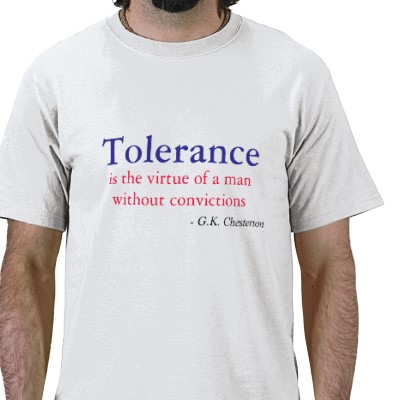
The Pseudo-Virtue of Tolerance

In this new progressive age in which we are living we are constantly lectured to by our leftist brothers and sisters about the absolute need for showing tolerance within our American society today.  Indeed, the necessity of practicing tolerance is preached from all levels of government, schools, social organizations, charities, and even some churches.  If one were to watch television for any prolonged sitting, it is a good bet that one would see a public service announcement stressing the need that we all act with tolerance towards one another.  Indeed, “tolerance” has been elevated to a virtuous level, or so it would seem. 

Now I understand the often altruistic intentions of many of those good folks that are decrying the need for tolerance in our society today, but unfortunately rather than improving society through our more tolerant actions, we seem to be debasing it often times and excusing actions and behaviors that used to be considered harmful, wrong, or sinful as just being part of the norm of everyday life now.  This sort of tolerance has defined deviancy down to the lowest common denominator often times.

Archbishop Charles Chaput formerly of the Denver Catholic Archdiocese and now of the Philadelphia Archdiocese is a brilliantly moral Christian man.  He also has a few critics because he is not one to bend Christian Catholic orthodoxy or doctrine, even if he were canonically allowed to do so, simply in appeasement to our new age demands to show greater “tolerance”.  Indeed Archbishop Chaput recently made a comment regarding this “tolerance trend” and put the non-virtue of tolerance into its proper perspective.  He stated,

“We need to remember that tolerance is not a Christian virtue. Charity, justice, mercy, prudence, honesty -- these are Christian virtues. And obviously, in a diverse community, tolerance is an important working principle. But it's never an end itself. In fact, tolerating grave evil within a society is itself a form of serious evil.”

What makes something a virtue?  Well, a virtue is something that when exercised is always for the truth and the doing of good.  Tolerance will sometimes fail to live up to that definition of virtuous behavior, if the very nature of something that is being tolerated is immoral or evil. 

Indeed, as a nation America has tolerated some great evils in its past regarding slavery and many of the actions towards our native American brothers and sisters, as some examples.  One can make the claim that many German citizens tolerated the initial abuses, for whatever myriads of reasons, in the rise of the Nazi Party and their systematic killing of the Jews.  Tolerance is not a virtue when the behavior one is tolerating is abhorrent, sinful, or evil.

The unfortunate irony of this call to tolerance is that often times those sometimes well-meaning folks espousing this pseudo-virtue are often the same ones showing a decided lack of tolerance towards those that disagree with their ideals or political agenda.  Indeed, one need only read the newspaper or turn on the nightly news to see myriads of examples of this intolerance coming from those that preach tolerance.

Often times our progressive friends will show contempt or disdain (certainly not tolerance) towards us conservatives and libertarians if we dare offer a contrary viewpoint on the veracity of anthropogenic global warming, gays in the military (or any LGBT issue), abortion, Christianity, radical Islam, evolution, just war, or government-compulsory wealth redistribution.  When it comes to many of these issues, to the typical progressive, their viewpoint is the “righteous” or humanistically moral one in their eyes, and thus they have no tolerance for those that would have the temerity to offer a differing opinion on the given subject at hand.  They are the moral, enlightened, and tolerant ones, you see.

So what then is the point of progressives espousing the need for all to be tolerant, even though they do not always practice what they are preaching?  Is it possible that there is something more behind this call for tolerance than simply a misguided altruistic attempt to get everyone to simply get along?  I am certain that many very good people have no other agenda than simply that aforementioned goal.  Unfortunately, I am also fairly certain that a not insignificant percentage of those tolerance-espousers are also trying to promulgate a more “tolerant society” that is in lock step with their political or world views.  In other words, they have an agenda.

This societal peer-pressured type of tolerance is seemingly being used more often as a form of control and censorship by the left in order to normalize what used to be unacceptable behaviors or ideals that were antithetical to American life.  The battle cry of “tolerance” thus becomes just another Saul Alinsky type of tool used to cow the timid conservative or the introverted libertarian into accepting what our western culture used to define as wrong, immoral, and in some cases just plain evil. 

It is my belief that we should all indeed strive to get along and love one another as we love ourselves, because every last one of us is indeed a sinner.  That said, when tolerance becomes a code word for cowing those from speaking out against what they know to be wrong simply to get along, our society will only continue to further slouch towards Gomorrah.   

Tuesday, March 15, 2011

The Theory of Moral Relativity

There have always been those in humankind that have done exactly what they wanted to do, regardless of what their society, culture, or creed dictated was moral. Unfortunately, since the 1960’s and the sexual revolution, it seems that this attitude has become ever more prevalent to the point that anything goes in today’s secular society and those that wish to still live by a moral code are typically seen as antiquated, rigid, prude, and intolerant of those whose mantra is “just because you think it is wrong, does not make it wrong for me!”

Before we delve into this further, let’s define a few terms here.

Moral Relativism: There are no absolute truths when it comes to moral judgments. Indeed, the truth of moral judgments are absolutely relative to the context of the individual or group. What one person or group might find to be moral and the truth may very well not be for another person or group. Further, there is no valid intrinsic standard of morality by which to compare them. Without such a standard for a frame of reference, it is a wasted exercise to try and determine the morality, the right or wrong of one’s decisions and actions in a morally relative environment. Morality is changeable, subjective, and individualistic to the moral relativist.

Moral Absolutism: There are very clear and well defined moral judgments that are absolutely true, regardless of one’s culture, society, or value system. There are definitive judgments of right and wrong, good and evil that transcend cultures and societies and are absolutely true for all humankind regardless. Natural law and a strong reliance upon it is typically a key component of it.

Nihilism: This is a belief that comes about when one accepts the premise of moral relativism as being true. Since moral beliefs and judgments are all relative to the individual or group and there is no overarching standard of reference, all moral conversations are meaningless. Morality is a relative thing and therefore the definition of it is abandoned. It is a belief in nothingness.

For those that know me or have read my blog for any length of time at all, it probably won’t surprise you to learn that I fall into the moral absolutism category, as it is my considered opinion that the belief in moral relativism creates the slippery slope that invariably ends with a belief in nihilism and a certain kind of secular totalitarianism.

Peter Kreeft writing in his A Refutation of Moral Relativism states,
“Peter Maurin and Dorothy Day defined a good society as one that makes it easy for you to be good. Correlatively, a free society is one that makes it easy to be free. To be free, and to live freely, is to live spiritually, because only spirit is free—matter is not. To live spiritually is to live morally. The two essential properties of spirit that distinguish it from matter are intellect and will—the capacity for knowledge and moral choice. The ideals of truth and goodness. The most radical threat to living morally today is the loss of moral principles.


Moral practice has always been difficult for fallen humanity, but at least there was always the lighthouse of moral principles, no matter how stormy the sea of moral practice got. But today, with the majority of our mind-molders, in formal education, or informal education—that is, media—the light is gone. Morality is a fog of feelings. That is why to them, as Chesterton said, ‘Morality is always dreadfully complicated to a man who has lost all his principles.’ Principles mean moral absolutes. Unchanging rocks beneath the changing waves of feelings and practices. Moral relativism is a philosophy that denies moral absolutes. That thought to me is the prime suspect—public enemy number one. The philosophy that has extinguished the light in the minds of our teachers, and then their students, and eventually, if not reversed, will extinguish our whole civilization.”

There are various reasons why some individuals choose to live with a seemingly oxymoronic code of moral relativism, and I would encourage you to read more of Mr. Kreeft’s excellent dissertation on the particulars here. Suffice it to say that for reasons ranging from psychological, cultural, social conditioning, to “tolerance” etc., far too many people try to justify their belief in this Nihilism.

Many folks do this from a sense of “enlightened” superiority in the mistaken assumption that our way is not the only right way to live. The moral relativist wants to be happy and therefore being able to live up to the “tougher standards” of moral absolutism is typically found to be exceptionally difficult. Failure to do so brings about guilt and a lack of self esteem at the failure to live by a transcendent moral code, hence the desire to cultivate only one’s happiness through the justification that all people should be tolerant and thus allowed to live as they choose.

While I would not ever be for forcing people to live by a moral absolutism code, that doesn’t mean that I won’t try to the best of my ability to live so personally and thereby hopefully provide an example for others as a contrast in the life they might have chosen. I realize that I always fall short of the moral code that my Christian faith and Western culture as defined by traditional American values prescribes, but far better for me to have goals that often exceed my grasp, than to have no moral goals at all for which I succeed at masterfully.

Indeed, living a life of moral relativism opens the door to everything being permissible. It is in such an environment where one states, “I am personally against abortion, but others can get one if they choose,” or to the extremes of “I personally don’t agree with homicide bombers, but I can understand their reasons for engaging in such desperate acts”. It is this thought process that creates that slippery slope from black and white, right and wrong, to everything being gray and some otherwise pernicious behavior being acceptable and permissible for some folks. Just because a Nazi thinks that genocide is okay, does not make it so. Just because some cultures insist on the mutilation of girl’s genitalia, doesn’t make it right. Just because a person practices a faith other than fundamentalist Wahabi Islam, does not make it right for that person to be executed in some nations, and yet all of these things have and do occur. To the true moral relativist, we should not judge these people/groups and hold them to our own moral standards of what is “right”.

At Mass this past Sunday, our priest pointed out that Satan doesn’t typically try to seduce the corrupt and those not living by any moral compass, as he typically already has those people in his grasp. It is those that are trying to be righteous that he focuses upon the most. In capturing them, he finds victory. Further, it is not through the temptation for the commission of grave or mortal sins by a person trying to live by a moral absolutist life that Satan typically tries to ensnare them, as most folks that try to live a righteous life are not typically able to be easily swayed to commit murder or steal or commit any other such obviously wrong actions.

Rather it is precisely through moral relativism that Satan will be most successful. Indeed, there often is the appearance of truth in some morally relativistic arguments that could persuade an otherwise morally absolutist person into abandoning his or her code to consider such actions as justifiable. Grandma is terminally ill and has lived a long life; she doesn’t want to be in constant pain, so we should do the merciful thing and help end her life compassionately. Of course this justification starts the slide down that slope to the next step of “Grandma doesn’t want to be a burden on the family and live out the rest of her life alone in the nursing home.” Then it becomes only a few generations away to the value of the elderly being deemed as unimportant or even as nuisances in this morally relativistic society. Such is the cost of abandoning a moral absolutist code and proclaiming that everything is permissible as an individual or group so desires. It creates a world where only might will eventually protect oneself as this secular anarchy will come to rule. Such is not a world in which I ever hope to live.

Monday, March 7, 2011

Reason, Passion, and the Soul

Nearly four hundred years before Christ walked this earth as fully man and fully God, Plato within his dialogue Phaedrus, created a rather interesting allegorical representation for a person’s soul. 

Plato described a charioteer being pulled by two winged horses.  The charioteer himself was seen to be the reason and intellect of the soul that must guide the stallions to enlightenment.  Now one of the steeds is pictured to be of noble breed and character and representative of rationality and moral impulse of a righteous nature, while the other of the two horses was the diametric opposite in bearing and virtue and thus represented the soul's irrational passions, appetites, or decidedly more base natures.   The two horses of such disparate natures were exceptionally hard to drive accordingly as they each wished to venture towards their own predilections, while the charioteer struggled mightily to drive them to his wanted destination of that elusive enlightenment.

It is a story of which I first learned back in high school the better part of three decades ago, but was recently reminded of a few weeks back in the homily at Mass one Sunday.  In the homily, our deacon spoke of the soul that is the Charioteer driving the winged twin horses of reason and passion. 

While perhaps not truly faithful to Plato’s original story, one can see the troubles that the charioteer soul might encounter when one steed tries to pull the chariot in one direction at the expense of the direction that the other steed wishes to travel, and thereby going to a place that the soul neither intended nor wished to venture.

If the horse of passion is allowed full rein to pull the chariot at the expense of the horse of reason, one might very well find one’s soul fulfilled, albeit for a very short lived time, as we do not live in a world where rationality and logic are absent for long, and thereby the consequences of having ignored them will quickly become apparent to the soul with excruciating and even grave consequences.

Indeed, fall in love with someone where the physical chemistry is magnificent initially, but the character or intellect are wanting and one will soon find that passion to falter and extinguish, leaving the soul injured and longing. 

At the same time, if one were to marry and commit oneself to a person for practical matters that made unassailable logical sense, as the person was of sterling character, quality, and the perfect complement to one in all things of a pragmatic nature, but yet there was no chemistry or passion and love for that individual,  it would be a marriage that too would soon falter as the purpose and meaning of such a marriage would never be fully realized.

The consequences of such disproportionate reason and passion, in favor of either steed, can likely be found applicable to any number of one’s relationships, career, vital interests, or critical elements to that which makes us each lacking in our own humanity.  I suspect that in all things, ensuring that there is a balance of reason and passion would ultimately make for a much longer lasting and far more fulfilling  life’s journey within the context of the soul driving that chariot.

Indeed, when passion and reason are yoked equally, one will find the chariot soul easy to steer towards that wanted destination and the journey will prove to be far smoother and enjoyable for the traveling.

Thursday, October 28, 2010

The Mormon Church and Being Gay

I came across this story (read it at this link) regarding a subject that has garnered much attention around the state of Utah where I now live and I found it rather interesting. 

Twice a year, the Church of Jesus Christ of Latter Day Saints (The Mormons) hold what they call General Conference Weekends where there are many speeches and sermons given by church elders and various leaders on any number of subjects dealing with Mormon theology, culture, and other issues relevant to the church and its members.

Well on October 3rd, during the latest General Conference, the second highest ranking member of the Mormon Church hierarchy, Boyd K. Packer, gave a sermon affirming the Christian and Mormon teaching that the practice of homosexuality is immoral and a sin.  Needless to say, this caused a huge uproar in Salt Lake's fairly sizable gay community, and indeed throughout the nation.  Many folks have decried and protested the sermon and have asked the Mormon Church for a retraction of Elder Packer's comments accordingly.

Now as any of you know that have read my blog, I am definitely not Mormon but rather am devout in my Catholic faith.  That being said, I admire and share many of the same moral beliefs and teachings that my Mormon brothers and sisters espouse.  Scripturally, the Bible is clear that homosexual acts are immoral and sinful.  There is no room for debate on this fact.  That the Mormon faith or any other religious faith based on the Bible would thus unequivocally affirm and state this truth should not be surprising to anyone accordingly.

That being said, having proclivities towards same sex attraction is not the sin.  It is acting upon those urges that brings us out of communion with God, just as knowingly turning away from His wishes in any matter is sinful and similarly disconnects us from communion with Christ. 

My personal opinion is that there is likely a genetic or biological component in many gay folks that fosters this same sex attraction.  I will leave the "normalization" of the gay lifestyle in current American culture that almost encourages confused or troubled teens and young adults to explore if they are "gay" as a separate issue for future discussion.  What I am speaking of is those people that have had this attraction since they first became aware of their own sexuality.

Acting out on these urges is typically quite self destructive and often leads to a lifestyle that finds much discontent and lack of harmony.  I would submit that this is because one has turned his back on God's admonition against homosexuality.  One has committed sin.

If one had a predilection towards alcoholism in one's family, would it not be best to simply avoid alcohol if one finds that the consumption of such in moderation is just not possible?  Just as someone that has such a biological component towards alcoholism knows this is true deep inside, they are often in denial and partake of that which ultimately causes them conflict and trouble in their lives.  Similarly, I suspect such is typically the case for many of our gay brothers and sisters that act out on their homosexual attractions as well, despite the ultimate sorrow and discontent that doing so causes them.

Now I absolutely condemn those that would ostracize, ridicule, or engage in hateful speech or actions towards gay people, or indeed towards any person that is "different" from what we think the norm should be.  Indeed, Christ tells us to hate the sin, but love the sinner.  And we are ALL sinners in some form or the other. 

Far better to reach out in love and compassion towards our fellow man and woman that are burdened with gay proclivities than to persecute them.  That is not what Christ would do and although I am certainly unworthy and fall far short of His will quite often, that is nevertheless what I try to do as well.

Wednesday, December 9, 2009

Is Life Still a Right for Modern-day Democrats?


I have long been troubled by the few cars parked in the lot of my Catholic church, presumably by parishioners there, that have the audacity to have Obama bumper stickers upon them. Now I understand that historically there has been a strong tie between the Catholic Church and Democrats in this country; however, what I do not understand is how people can put a political party affiliation above that of God’s commandments. Frankly I would rather draw the ire of the likes of supposed Democrat Catholics like Nancy Pelosi , John Kerry, and the numerous iterations of Kennedys in congress instead of having to explain myself to our Lord come judgment day about my support for abortion.

Make no mistake; I am a huge sinner and have much to atone for; however, I don’t understand how a supposedly faithful Catholic (or Christian of any stripe for that matter) can vote for the likes of Obama who champions abortion. I also understand the purported social justice reasons for supporting Democrats. Never mind that Democrat policies often end up hurting rather than helping the poorest among us in most cases. Putting that aside though, even if one does agree more with the Democrat philosophy and agenda, shouldn’t the right to life trump all?

I applaud those rare courageous Catholic Bishops that have issued edicts against giving Holy Communion to a politician that is supportive of abortion.
If only all of the Bishops, Priests, and Deacons would have the courage to speak out unequivocally in support of life and back it through their actions, perhaps we would see an actual decline in the number of abortions we tally as a nation each year. Regardless, how can one in good conscience take part in the Holy Eucharist and then not seek to protect life that Christ created?

The church teaches us to love and respect and protect life from conception to natural death because that is what God wants. God did not create life just so we could kill it if it becomes inconvenient to us. I was appalled when then-senator Obama said during the campaign that he wanted to keep abortion legal as he wouldn’t want his daughters to be “punished with a baby” should they make a mistake. Unfortunately, Obama has also been supportive in voting for the most extreme and gruesome forms of abortion, such as partial birth abortion, when even many pro-abortion supporters draw the line before that point.

And now with the Democratic Congress and President rushing through this monstrous and evil health care bill which will provide for federally funded abortions, as the legislation currently stands, and will certainly end up rationing care to the sick and elderly in order to save money by shortening their lives, one has to wonder just how far we as a nation must stray before our “just reward” is meted out to us. I shudder to think what the consequences will be.

And for you pro-abortion supporters, I want to make clear that I do not hate those people that have chosen to abort their babies. On the contrary, I feel immensely sad for them and pity them. May God comfort them and help them through their pain of having had to make such a choice. And may He bless those that have moved on after that and come to realize that choosing and defending life is what He wants for us all.